
WHY WE NEED COLLABORATION TO RETHINK BLADDER MANAGEMENT
By Edward Cappabianca, CEO, Ingenion Medical
I've just returned from Lisbon, where I had the privilege of speaking at the Live Surgery Urogynaecology Course, an engaging gathering of clinicians from across Europe, united by a shared commitment to pushing the boundaries of patient care. It was the kind of event that reinforces exactly why innovation in healthcare matters.
My talk focused on cymactive™ and what I believe is a long-overdue conversation surrounding bladder management and the need to rethink our approach.
The Problem That We've Been Living With
Let me start with a number that still surprises people when I say it out loud: the basic design of the Foley catheter has barely changed since the 1930s. Think about that. In a world where surgical techniques, imaging technology, and pharmacology have been transformed beyond recognition, the most used urinary catheter has remained essentially static for nearly a century.
For patients living with chronic urinary retention, a condition requiring catheterisation or bladder management for weeks, months, or even long-term, this matters enormously. Traditional indwelling catheters create a permanent reservoir of urine in the bladder, and bacteria can migrate along the outer catheter surface, providing a direct route for bacteria that can lead to infection. We know that catheter-associated urinary tract infections (CAUTIs) are among the most prevalent healthcare-associated infections, accounting for an estimated 70–80% of hospital-acquired UTIs. For patients managing their condition in the community, this translates into pain, disruption, unplanned GP visits, and hospital admissions, a cycle that is exhausting, undignified, and entirely avoidable.

Intermittent catheterisation, the alternative for many patients, carries its own burden. Systematic reviews have found UTI rates ranging from 26% to 63% among people using intermittent catheters. That's not a minor side effect; that's a significant complication affecting a large proportion of the very people we're trying to help.
And beyond infection, there's the daily reality of life with a traditional catheter: drainage bags, restricted mobility, concerns about body image, and the constant awareness of a device that announces itself to the world. For patients who are trying to work, travel, care for their families, and live fully, this is a genuine barrier to quality of life.
A Better Way Is Possible
Our bladder management system, cymactive™, started from a simple question: what if a catheter could work with the body rather than around it?
The urethra is part of the body's natural defence system against infection, a closed, mucosal tube that keeps bacteria out when it's functioning normally. Traditional catheters disrupt that defence by holding the urethra permanently open and creating a continuous drainage pathway. cymactive™ is designed differently. It's almost an entirely internal, self-retaining device with a patient-controlled magnetic valve. The patient uses an external magnet near the scrotum to open the valve and void, closely mimicking the natural process of urination, and the valve closes again once voiding is complete and the Actuator magnet is moved away.
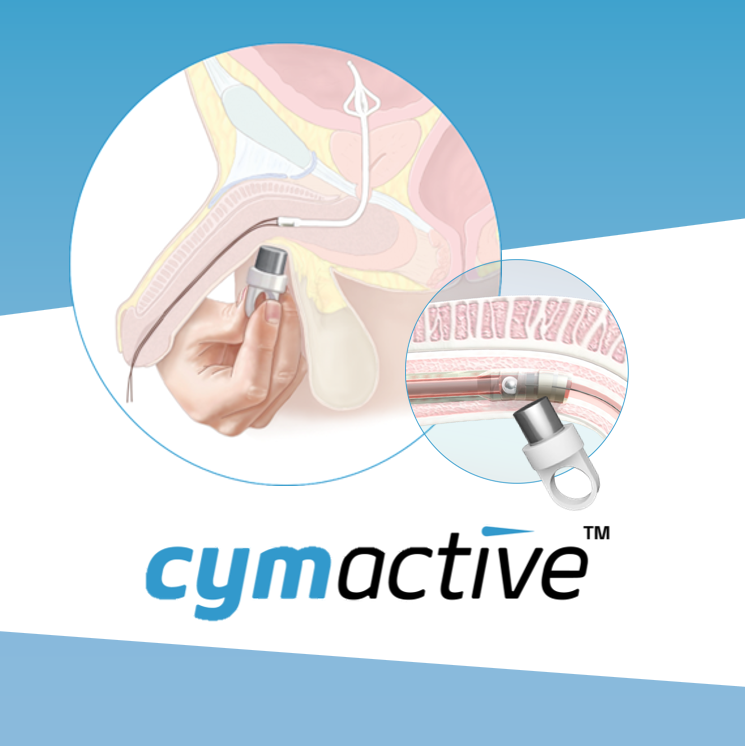
With a drainage hole at the base of the indwelling malecot, the result is cyclical bladder filling and emptying, rather than continuous drainage. We believe that the design can support the urethra to retains much of its natural barrier function. There are no external drainage bags, no repeated insertions, and no permanent reservoir of stagnant urine. CE-marked for up to 30 days of use, cymactive™ combines the stability of an indwelling catheter with something closer to the autonomy of normal bladder function.
For patients with the manual dexterity to use it, this represents a genuinely different experience of managing their condition.
Why Industry and Healthcare Must Work Together
Whilst I do believe that our device can make a genuine improvement to a person’s quality of life, developing and deploying a device like cymactive™ is not something a medical technology company can do alone. The gap between a promising innovation and real-world patient benefit is bridged by clinicians, and that bridge must be built collaboratively, with honesty on both sides.
What struck me at the Urogynaecology Course in Lisbon was the quality of the dialogue. Healthcare professionals weren't simply listening to industry presentations; they were probing, questioning, sharing their own clinical observations, and challenging assumptions. That's exactly what we need.

When commercial companies come to healthcare providers with new technology, the conversation must go two ways. We bring data, evidence, and engineering insight. Clinicians bring something irreplaceable through the knowledge of what it actually feels like to look a patient in the eye and explain their options, to troubleshoot complications, and to understand the nuances of how a condition presents across a diverse patient population.
The best outcomes happen when that exchange is genuine. Not a sales pitch followed by polite applause but a real working relationship where feedback loops back into product development, clinical protocols are designed with frontline input, and both sides share accountability for whether patients are actually better off.
At Ingenion, that's the relationship we're committed to building. We know cymactive™ is not the right solution for every patient, and we'd rather clinicians tell us that honestly than fit the device to cases where it won't serve people well. What we ask for in return is the openness to consider new approaches, and a willingness to challenge the assumption that because something has been done a certain way for over 90 years, it must be the right way.
What Comes Next
The conversations in Lisbon reinforced my belief that we're at an important moment in bladder management. The clinical community is genuinely interested in moving beyond the status quo. Patients are asking for more. And the tools now exist to deliver something meaningfully better.
I left Portugal energised and with a clearer sense of the clinical questions we still need to answer, the partnerships we need to build, and the patient voices we need to keep at the centre of everything we do.
If you're a clinician, researcher, or patient advocate interested in cymactive™ or in exploring what a collaboration with Ingenion Medical might look like, we'd love to hear from you. This is exactly the kind of conversation that changes outcomes.
If you would like to find out more, please use the contact form below.
References
Oswald J, et al. Staff and patient perceptions of a community urinary catheter service. International Journal of Urological Nursing. 2020;14(1). https://doi.org/10.1111/ijun.12230
Ingenion Medical. Meet cymactive. ingenionmedical.co.uk/cymactive. Accessed May 2026.
D'Ambrosio F, et al. The frequency of UTIs in people who undertake intermittent catheterisation: a systematic review. BMC Urology. 2022. https://www.ncbi.nlm.nih.gov/pmc/articles/PMC9594201/
Oswald J, et al. Op. cit.
Homan HD, et al. Safety and efficacy of a patient-controlled bladder management system for treating urinary retention in men. Neurourology and Urodynamics. 2016;35(5). https://doi.org/10.1002/nau.22770
Ingenion Medical. cymactive - CE Marked Intraurethral Catheter. ingenionmedical.co.uk. Accessed May 2026.